
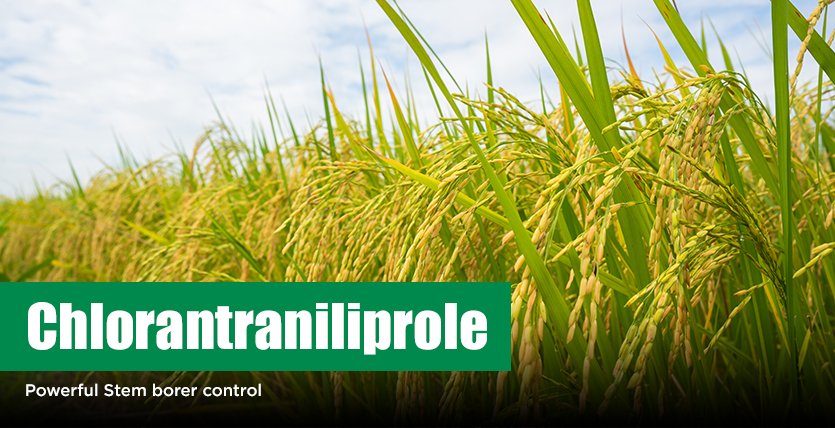
In crops such as rice and sugarcane, stem borers remain one of the most damaging insect pests. These larvae enter the plant soon after hatching and start feeding inside the stem. Because the pest remains protected within the plant tissue, visible damage often appears only after the internal feeding has already started. Symptoms like dead hearts in rice or damaged shoots in sugarcane are clear signs that the pest has already affected plant growth.
For this reason, early stage pest control becomes extremely important. Chlorantraniliprole 0.4% GR is designed to address this challenge by targeting the larvae when they begin feeding. The formulation delivers the insecticide in granular form, allowing it to be applied directly in the crop field where early pest activity occurs.
How Chlorantraniliprole Works
Chlorantraniliprole belongs to the anthranilic diamide group of insecticides and is known for its specific mode of action against caterpillar pests. Instead of acting on the insect nervous system like many traditional insecticides, this molecule affects the muscle function of the insect.
It works by activating the ryanodine receptors present in insect muscle cells. Once these receptors are activated, calcium ions are released continuously inside the muscles. This disturbs normal muscle contraction, causing the insect to lose coordination. As a result, feeding stops quickly and the insect gradually becomes paralyzed.
The important advantage of this mechanism is that crop damage reduces almost immediately because the larvae stop feeding soon after exposure.
Why the 0.4% GR Formulation is Used
Granular formulations are particularly useful in crops where pests develop close to the base of the plant or within stems. When Chlorantraniliprole 0.4% GR is applied in the field, the granules settle near the plant base. With soil moisture or irrigation, the active ingredient slowly releases into the surrounding zone.
This method allows the molecule to remain where young larvae begin feeding. Compared with foliar sprays, granules also reduce the challenge of achieving perfect spray coverage in dense crops such as rice.
Target Pests
Chlorantraniliprole 0.4% GR is mainly used to manage important caterpillar pests such as:
- Yellow stem borer in rice
• Leaf folder in rice
• Early shoot borer in sugarcane
• Top borer in sugarcane
Controlling these pests early helps prevent internal plant damage that can affect crop growth and yield.
Key Advantages
- Stops feeding of caterpillar pests quickly
- Effective against stem borers that remain hidden inside plants
- Granular formulation allows easy field application
- Supports early protection during critical crop growth stages
- Suitable for inclusion in integrated pest management programs
Best Use Practices
For effective results, the granules should be applied evenly across the field at the recommended crop stage. Soil moisture helps the active ingredient disperse properly, so light irrigation after application often improves performance. Avoid disturbing the soil surface immediately after application, as this may disturb the treated layer.
Conclusion
Managing stem borers requires early and targeted intervention because these pests quickly move inside plant tissues where they become difficult to control. Chlorantraniliprole 0.4% GR provides a practical solution by delivering a selective insecticide directly in the crop environment. Its specific mode of action and granular formulation help protect crops like rice and sugarcane during the stages when pest attack can cause the greatest damage.
Frequently Asked Questions (FAQs)
What is Chlorantraniliprole 0.4% GR used for?
It is mainly used for controlling caterpillar pests such as stem borers and leaf folders in crops like rice and sugarcane.
How does it control insects?
The molecule affects insect muscle function by activating ryanodine receptors, which causes feeding to stop and eventually leads to paralysis.
Why is the product in granular form?
Granules allow the insecticide to be applied directly in the field where pests begin feeding near the plant base.
Does it control already established pests inside the plant?
It works best when applied early, before the pest population becomes well established inside the crop.