
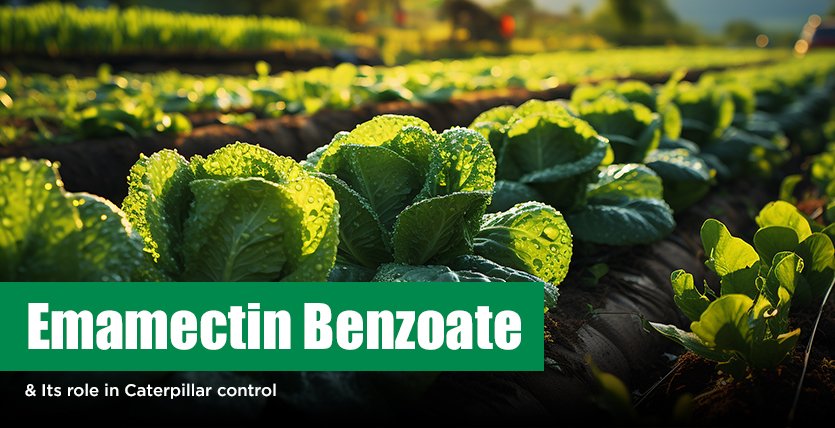
Growers who work with sensitive crops know how quickly a small Caterpillar infestation can destroy a large area of field. Many chemical groups lose their strength after a few years because the insects learn to survive them. This is where emamectin benzoate has earned a special position in crop protection. It belongs to a group of fermentation based compounds that interfere with the insect nervous system and slowly shut down the feeding activity. This action helps growers protect both fruit bearing crops and leafy crops with a more reliable performance.
How Emamectin Benzoate Works Inside The Plant Tissue?

When we talk about emamectin benzoate we are actually talking about a refined form of a natural substance that comes from soil bacteria. These soil organisms produce complex molecules that affect nerve signals. When scientists isolated these molecules and modified them for crop protection, the result was an active ingredient that works in very small quantities but gives deep control inside the plant tissues. This explains why many growers prefer it for crops like cotton, chilli, cabbage, pigeon pea, okra and several orchard crops.
The biggest challenge with caterpillar pests is that they hide within folded leaves or bore inside fruits and pods. Because of this behavior simple contact insecticides remain on the surface and do not reach the feeding site. Emamectin Benzoate performs better because it moves inside the leaf tissue and creates a toxic environment for the larvae. As soon as the caterpillar takes a small bite, the active ingredient begins to affect the muscles and the insect is unable to continue feeding. The insect does not die immediately but the feeding stops within a few hours, which is what protects the crop from further damage.
Difference Between the Two Formulations Offered in the Market
Many brands in the agro market offer different formulations of the same molecule. A formulation is basically the way the product is prepared for spray or field application. Peptech Biosciences offers two reliable forms that have been used across different climatic regions. One is Emamectin Benzoate 5% SG, which is a water-soluble granular form. Another is Emamectin Benzoate 1.9% EC, which is an emulsifiable concentrate form. Both carry the same active ingredient but the way they dissolve and spread on the plant surface is slightly different. This gives flexibility to buyers who want to choose based on their spray habits or the type of sprayer they use.
The soluble granular form is usually preferred where growers need easy mixing and stable suspension in water. The concentrate form is used when a fast spreading action on the leaf is required. Although the two formats are different, the underlying science remains the same. The active molecule binds with specific nerve receptors in the caterpillar body and reduces the chloride ion flow. This disrupts the normal muscle movement. When the insect loses control over its muscles, it cannot chew the plant tissue anymore and later dies naturally.
Below is a simple table that helps understand the common differences between the two forms.
| Parameter | Emamectin Benzoate 5% SG | Emamectin Benzoate 1.9% EC |
| Physical form | Water soluble granules | Liquid concentrate |
| Mixing behavior | Dissolves with steady agitation | Forms a stable emulsion in water |
| Spread on leaves | Slightly slower but uniform | Quick wetting and spreading |
| Typical use | General crop protection and routine sprays | Tough infestations and fast coverage needs |
Both formats are widely used for caterpillar pests like fruit borer, pod borer, diamondback moth, shoot borer and many more chewing insects. Since these pests cause direct damage to fruits, flowers or tender growth, the reduction in feeding saves the crop from visible losses. Growers who use this chemistry often notice cleaner fruits, better recovery of foliage and more uniform crop growth. Another point that supports the popularity of emamectin benzoate is that it works at very low dosage which reduces the chemical load on the field.
Importance of Emamectin Benzoate in Resistance Management in Crop Protection
It is important to understand how resistance management works. When growers use the same chemistry too frequently, there is a chance that the insect population slowly adapts. To avoid this problem most experts advise rotation with other insecticide groups. Emamectin Benzoate fits well into such rotation plans because it belongs to a distinct group with a unique nerve action. Using it in the correct interval helps maintain the sensitivity of the pest population.
Correct application plays a big role in the final result. The spray must reach the undersides of leaves where the larvae hide. A uniform spray volume ensures that the active ingredient is available across the canopy. For crops with thick foliage like chilli or brinjal, proper nozzle selection further improves the coverage. Because emamectin benzoate has strong activity on young larvae, many field advisors suggest early monitoring of eggs and first instar stages. Early intervention often reduces the number of follow up sprays.
Safety is another point that many brand owners look at before choosing a molecule for their product portfolio. Emamectin Benzoate is considered relatively safe for most beneficial insects when used at recommended doses. Its specific nerve action targets caterpillars more strongly. This allows other useful insects to recover faster after application. For businesses that supply inputs to growers, this profile helps in building trust and long term relationships.
Why Choose us?
Peptech Biosciences Ltd. makes both the 5% SG and the 1.9% EC forms suitable for bulk supply and white label needs. The company prepares these formulations with controlled fermentation-based active ingredients, quality-checked solvent systems and stable carriers. This helps in maintaining consistency batch after batch for large-scale buyers who require dependable quality for their own brands. When discussing technical partnerships with clients, the company usually explains the difference in application routines, dosage windows and crop suitability so that the client can choose the most appropriate grade.
Conclusion
In summary, emamectin benzoate has become a major tool for crop protection because it combines natural origin, precise nerve action and strong feeding inhibition. Whether it is the soluble granular form or the concentrate form, the active ingredient continues to serve as a dependable option for caterpillar control. Buyers who work closely with agricultural brands will find that this molecule fits well in many crop programmes and remains relevant in modern pest management strategies.
Frequently Asked Questions (FAQs)
Q1. What makes Emamectin Benzoate different from normal contact insecticides?
A. Most contact insecticides stay only on the leaf surface. They cannot reach the larvae that hide inside folded leaves or bore inside fruits. Emamectin Benzoate moves inside the plant tissue and becomes available exactly where the larvae feed. This is why its feeding stop action is faster and more dependable.
Q2. Can both formulations work on the same crops?
A. Yes, both the 5% SG and the 1.9% EC forms can be used on many similar crops like chilli, okra, brinjal, cotton and cabbage. The choice depends more on the spray preference and the handling experience of the user.
Q3. Does Emamectin Benzoate kill insects instantly?
A. It does not kill instantly. What it does first is block the nerve signals of the caterpillar. When this happens, the insect cannot chew or move properly. Feeding stops in a few hours and the insect dies later. The important part is the feeding stop because that protects the crop.
Q4. Is it safe for beneficial insects?
A. When used at recommended doses, it is considered comparatively safe for many beneficial insects. Its action is more targeted toward caterpillars. So predators and pollinators generally recover quicker after exposure.
Q5. Why do some farmers prefer the SG form and some prefer the EC form?
A. Some people like the SG form because it mixes very cleanly in water and stays stable in the tank. Others prefer the EC form because they want a quicker spread on the leaves during heavy pest pressure. Both forms deliver the same active ingredient; only the mixing and spread behaviour are different.
Q6. Can insects become resistant to Emamectin Benzoate?
A. Yes, resistance can develop if the same group is used again and again without rotation. This is why rotation with other insecticide groups is advised. Using the product at the correct interval also helps in maintaining sensitivity.
Q7. Does it work better on young larvae?
A. Yes, early-stage larvae are more vulnerable to the feeding stop action. If the spray is timed soon after egg hatch, the caterpillar does not get enough time to feed and damage the plant.
Q8. What are the main pests controlled by this molecule?
A. It is widely used for fruit borer, pod borer, shoot borer, leaf folder and diamondback moth. These pests are among the most damaging chewing insects in many vegetable and fruit crops.